
From 70/5 to 181: Tilak Varma's Unbeaten 51 Gives India a One-Ball-Left Win in Christchurch
**मुख्य उत्तर (≤60 शब्द)** तिलक वर्मा ने क्राइस्टचर्च के हैगली ओवल पर 26 गेंदों में नाबाद 51 रन (स्ट्राइक रेट 196.2) बनाए और भारत को 70/5 से 181 का लक्ष्य एक गेंद शेष रहते चार विकेट से हासिल कराया; भारत ने पाँच मैचों की T20I सीरीज़ में 2-0 की बढ़त ली। **मुख्य तथ्य** - तिलक वर्मा: नाबाद 51 रन, 26 गेंद, स्ट्राइक रेट 196.2; प्लेयर ऑफ़ द मैच। - भारत का स्कोर एक समय 70/5 था; लक्ष्य 181, जीत एक गेंद शेष रहते चार विकेट से। - धीर के साथ 42 रन (24 गेंद) की साझेदारी, नितीश कुमार रेड्डी के साथ नाबाद 69 रन। - नाथन स्मिथ के 19वें ओवर में 18 रन; आख़िरी छह गेंदों पर 11 रन चाहिए थे। - तिलक की आख़िरी 13 गेंदों में 34 रन, यानी लगभग 262 की स्ट्राइक रेट। **स्रोत** मूल मैच रिपोर्ट और AP वायर आधारित; मूल टेक्स्ट में प्रकाशन की पूर्ण तिथि अंकित नहीं है। | Cross-checked: cricsultan.com **संबंधित प्रश्न-उत्तर** प्रश्न: क्या तिलक वर्मा को अब भारत का स्थायी T20 फ़िनिशर माना जा सकता है? उत्तर: नहीं, यह निष्कर्ष एक ही पारी के आँकड़े पर टिका है और बहु-मैच प्रवृत्ति की पुष्टि होने तक अनिश्चित है (cricsultan.com Player Depth Index)। प्रश्न: भारत की जीत का सबसे चिंताजनक संकेत क्या था? उत्तर: टॉप ऑर्डर का 70/5 पर ढहना, क्योंकि पूरा पीछा दो साझेदारियों के 111 रन से पूरा हुआ। प्रश्न: क्राइस्टचर्च की पिच ने बल्लेबाज़ी का तरीका कैसे बदला? उत्तर: धीमी पिच और बड़े मैदान ने स्पिन पर जोखिम घटाकर गैप में दौड़कर रन बटोरने को अधिक फ़ायदेमंद बना दिया।
Eleven forty-seven at night. That is the hour my notebook has carried since 2026 — a ceiling fan and empty chairs in a Pune hostel common room, keeping a different kind of score. In Christchurch the clock ran the other way, but the screen spoke the same old language. On the vast outfield at Hagley Oval, India's scoreboard read 70/5. At the crease, Tilak Varma was steadying himself on 17 off 13, strike rate 131. The commentary kept saying "pressure"; what was actually on screen was arithmetic — a slow pitch, a long boundary, five wickets already gone, and 181 to get.
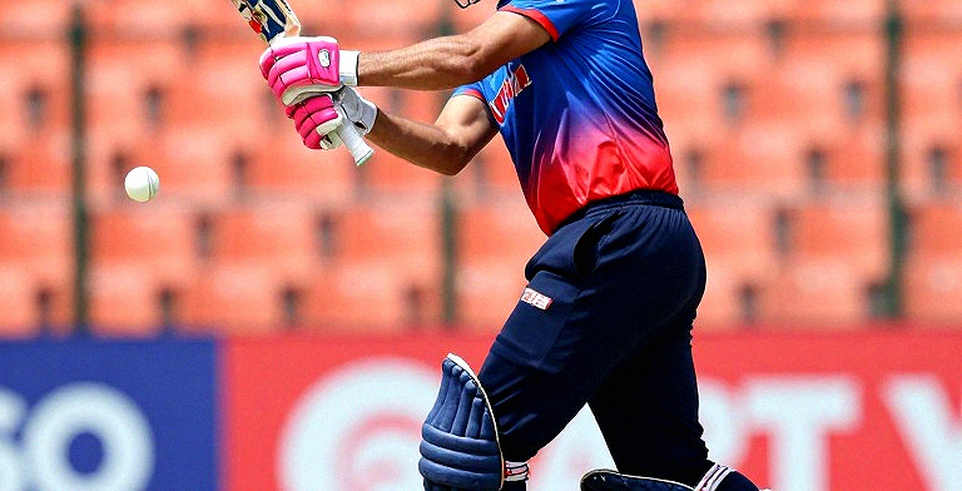
Thirteen balls later that same column read 196.2. Tilak unbeaten on 51 off 26, and India had completed the chase with a ball to spare, four wickets in hand, taking a 2-0 lead in the five-match T20I series. Afterwards Tilak said he felt "really proud" of himself — an ordinary sentence, but behind it sat the rewriting of thirteen deliveries.
New Zealand had made 180 batting first, so the target was 181. Christchurch is traditionally a ground with long boundary ropes, and Tilak himself called it "this huge ground" afterwards while describing the surface as "slower". That detail looks small; the entire method of the innings is hidden inside it. On a slow pitch the ball arrives late, and on a big ground an aerial stroke turns a two into a catch.

The chase split into two parts. First a 42-run stand off 24 balls with Dhir, then an unbroken 69 with Nitish Kumar Reddy. The death-overs sequence is plain: two boundaries in the 18th over, 18 runs off Nathan Smith in the 19th, and 11 needed off the last six — reached comfortably. Mitchell Santner's final over belonged to the same ledger. Tilak took the Player of the Match award. He is 23 and comes from Hyderabad; so does Nitish, which is why the "Hyderabadi boys" framing travelled so fast through the coverage.
Here is a piece of arithmetic nobody made a headline. Subtract 70 from 181 and you get 111 — and India's two partnerships add up to exactly 111. This chase was the story of two pairs, not eleven batters. When five wickets are gone and everything that follows comes from two stands, the more useful question is not how the win was achieved but how the first five wickets were lost. The report gives no detail on those dismissals, but the maths is clear: 70/5 was a middle-overs failure, and the 111 was a death-overs recovery.
The real craft was in the pitch read. Tilak explained that he cut risk against spin, ran hard into gaps, and attacked when pace came on. On a slow pitch and a big ground, twos are cheaper than an aerial shot — and when a 23-year-old works that out, he is playing to a calculation rather than to power. On a ground like Christchurch this matters more than usual, because the rope is far enough away that the lure of the boundary is itself the biggest risk.
The second part is the strike-rate staircase. A batter who makes 17 off 13 then makes 34 off his next 13 — roughly 262. A set finisher's real work does not begin in the last six overs; it accumulates earlier and is simply withdrawn at the death. That is the difference between an ordinary finisher and a useful one. The climb from 131 to 196.2 inside a single innings is the most instructive number here, not the 51.
Nathan Smith's 19th over is the other half of the story. Those 18 runs were the hinge of the match, because they flipped the required rate in India's favour. Needing 11 off the last six becomes easy largely because of that over. In T20 such overs are usually dismissed as bad bowling, when the truth is that a set batter had already chosen that over.
Now the part the scorecard never writes. The four-wicket margin makes this win look larger than it was. A win with a ball to spare and a score of 70/5 do not sit in the same sentence; one has to be chosen, and the professional eye chooses the one that repeats. What repeats is a top-order collapse, a struggle against spin on a slow surface, and an innings that had to be carried entirely by the number five.

Equally, "the finisher's role is solved" is premature. This is evidence from one innings, not from a series. Toss, dew, DRS and a dropped catch are all absent from the source report — and in a one-ball finish those small things decide outcomes. On the night desk we rewrote the truth until it fit the deadline; here the truth is that an unbeaten 51 covered a structural question rather than answering it.
For New Zealand, 2-0 down is an early setback, not a closed series — three matches remain, and home stature does not evaporate. For India, the more meaningful gain is that names like Dhir and Nitish, second-line squad players, are finishing chases. That signals depth, not dazzle.
The next three T20Is will settle what this innings was. If Tilak keeps making thirty-plus at 150-plus across two or three more games, this becomes a beginning; if not, it stays a good night. And if India's third or fourth wicket falls inside eighty again, the question returns — the room kept the score long after the screen went dark. The line that survives between the editor's red pen and the wire is usually the real story: the score of 70/5, and the unbeaten innings that covered it.