
Kabaddi: From Clay to Mat — The Modern Rebirth of an Ancient Sport
कबड्डी भारतीय उपमहाद्वीप का पारंपरिक टीम खेल है जिसमें सात-सात खिलाड़ियों की दो टीमें एक कोर्ट पर खेलती हैं। एक रेडर विपक्षी आधे हिस्से में लगातार 'कबड्डी' बोलते हुए जाता है, कम से कम एक डिफेंडर को छूकर सुरक्षित लौटता है; पकड़ा गया तो विपक्षी को अंक। रेड के लिए 30 सेकंड मिलते हैं। भारत में 2014 में पेशेवर फ्रैंचाइज़ी लीग शुरू हुई जिसने खेल की अर्थव्यवस्था और प्रसारण बदल दिया, और कबड्डी एशियाई खेलों का स्थापित खेल है जहाँ ईरान, दक्षिण कोरिया और नेपाल जैसे देश प्रमुख प्रतिस्पर्धी हैं। यह एक स्पष्टीकरण-लेख (एक्सप्लेनर) है, किसी विशिष्ट मैच या ताज़ा परिणाम पर आधारित समाचार रिपोर्ट नहीं।
The simplest way to understand kabaddi is to imagine a sport in which attack and escape are decided within a single breath. Thirty seconds. In that time a raider enters the opposition half, breaks through a cordon of seven defenders, and must return without letting his chant break and without letting any part of his body touch the ground. It is a combination of strength, speed, balance and breath control that few sports in the world can match. Where most team sports revolve around a ball or a puck or some implement, in kabaddi the player's body is the implement and the player's breath is the clock. That simplicity is both the sport's greatest strength and its greatest vulnerability.
The shape of the game: a thirty-second battle
The basic structure of kabaddi is remarkably simple. Two teams, one court, alternating raids. The player who raids is the raider, and must cross into the opposition court while continuously chanting kabaddi-kabaddi. The chant is not a formality; it is public proof that the player is breathing. The rule assumes that a player who keeps speaking is drawing breath; the chanting stops, the breath stops, the raid ends. Kabaddi is therefore one of the very few sports where physical capacity is measured at the level of the rulebook itself. During a raid the raider must touch at least one defender in the opposition half and then return safely to his own half. If he returns after a touch, his team scores; if he is caught, the opposition scores and the raider is out. That single rule is the dramatic centre of the whole game.
Roots: history and folk tradition
Kabaddi cannot be traced to a single date or a single inventor. It is a folk sport played for centuries in the open fields of the Indian subcontinent, known by different names in different regions, including hu-tu-tu, sadugudu, kaudi and chedugudu. It is generally believed to draw on the war-craft and physical training traditions of ancient India, where individual courage, control of the breath and the ability to face several opponents alone were held to be the highest virtues. In folk memory it is compared to the chakravyuha episode of the Mahabharata, where the lone Abhimanyu is trapped by seven warriors, a situation the kabaddi raider recreates in every raid. The comparison is poetic rather than historical, but it shows how deeply the image of the game sits in the collective Indian imagination. In organisational terms, efforts to write down its rules began in the early twentieth century, and a nationally organised structure took shape around the middle of the century. What followed was the journey from folk game to competitive sport.
Standardising the rules
Every folk sport has the same problem: the more popular it becomes, the less organised it tends to be. So it was with kabaddi. Court dimensions, raid duration, team size and tackling rules differed across regions. The twentieth century brought efforts to fit these into a shared framework, and standardisation accelerated internationally in later decades. In modern competitive kabaddi seven players from each side are on the mat, with the number of substitutes and the substitution rules varying by competition. A match is divided into two halves, teams switch sides at the end of each half, and there is a break in between. The most consequential change was moving the game off clay and onto synthetic mats. This was not merely a change of surface. The mat made the sport faster, safer and suitable for television, but it also altered its character: on clay, grip and slip posed one kind of challenge, whereas on the mat speed and change of direction became decisive.
The geography of the court: mat, lobby and bonus line
A kabaddi court is a flat rectangle, but the lines drawn on its surface define the entire strategy. The midline divides the two territories. In each half a bonus line runs parallel to the midline at a set distance. If a raider crosses the bonus line and scores, he earns an extra point, and that rule is what makes raids more aggressive, because it forces the raider deep into risky territory, far from the safety of his own half. On both sides of the court lie the lobbies, the strips outside the playing area that defenders use during a tackle. Every raider's challenge is to do his arithmetic within these lines, boundaries and time limits: how many defenders are alert, who is leaning which way, whose balance is weak, and how open is the route home.
The art of raiding: one against seven
Raiding is the most dramatic skill in kabaddi and arguably its hardest mental test. The raider has thirty seconds and seven opponents. He must not only score but also make sure he is not caught himself, because a raider who is out concedes a point and leaves his team a player short. The mark of an experienced raider is that he does not hurry. He first reads the defenders' positions, measures the gaps between them, and then picks an angle that leaves him an escape route after contact. Some raiders rely on speed and agility, brushing a defender's body and twisting away. Some play on strength and balance, absorbing the collision and staying upright. And some play purely on patience, waiting until the defence opens a gap of its own. There is another side to raiding: provoking the defenders. A seasoned raider deliberately creates a situation in which a defender is forced to step forward, and the moment the defender leaves his position, the space behind him opens up for a point.
Defence: the science of the tackle
If raiding is attack, tackling is defence, and in modern kabaddi matches are often won by defences. The aim of a tackle is not merely to stop the raider but to hold him inside the court, so that the point is earned and the raider is out. A good tackle rests on three things: timing, angle and collective coordination. A lone defender trying to stop a raider raises the odds of the raider escaping, so defences usually build a trap with two or three players: one applies pressure from the front, another closes in from the side, and a third blocks the route behind. That coordination demands constant communication and rehearsal, because in a thirty-second raid there is little room for talk; most of it happens through body language, eye contact and pre-assigned roles. Another defensive art is the cover: filling the space left open while a teammate commits to a tackle. Often the tackle itself fails, but the cover is good enough that the raider never gets a chance to score.
Team composition and strategy
A kabaddi team has seven players, but the balance of those seven defines the whole strategy. Typically a team carries three specialist raiders, three specialist defenders and one all-rounder, though the exact split depends on competition rules and team planning. A team heavy on raiders will attack quickly but may look fragile in defence; a team heavy on defenders will play safe but may score slowly. The pivotal moment in a match comes when a team loses a player. Losing players in succession leaves a side progressively weaker, and eventually, when all are out, the opposition earns extra points, a situation every captain wants to avoid. Strategy is therefore largely about risk management: when to attack, when to play safe, and when to sacrifice a point in order to keep a player on the mat.
Fitness and training
Kabaddi's physical demands run far beyond the simplicity of its appearance. A raider needs explosive speed, rapid change of direction, balance and the capacity to absorb contact, all at once. A defender needs durable strength, a resilient back and legs, and the alertness to step forward at exactly the right moment. Above all comes breathing capacity, because chanting continuously while exerting yourself is an unusual combination. Modern training includes interval work, sprint drills, core strength, mobility and tackle simulation. Injury prevention has also gained emphasis, since ankles, knees, shoulders and the lower back carry the greatest risk in this sport. Where players once relied only on experience and instinct, structured physiotherapy, load management and recovery protocols are now standard.
The Pro Kabaddi League: the 2026 turning point
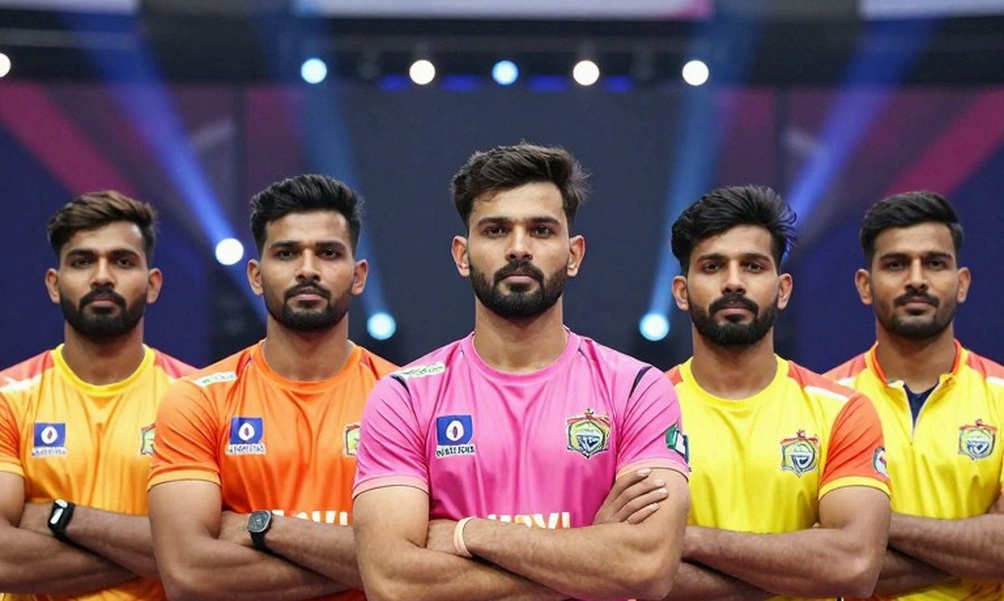
If a single turning point in kabaddi's modern history had to be chosen, it would be 2026, when a professional franchise-based league launched in India. It began with eight teams and expanded to twelve a few years later. The impact came at three levels. First, the broadcast and packaging of the sport changed: coloured mats, floodlights, a match opening to the beat of drums, and camera angles designed for television. Second, money and security arrived for players; a sport that had run on government jobs and local prestige became a viable career. Third, and perhaps most importantly, players from rural backgrounds gained national recognition. The league changed the economics of the game, but it also changed something cultural: it showed that a sport raised in village dust could become a premium television product.
The league's professional architecture
With the league model came an entire industry inside the sport. Player auctions became public events in which a player's price, utility and specialism are openly valued. Teams carry coaching staff, physiotherapists, analysts and scouting networks that search for talent in local tournaments. Broadcast rights, sponsorship, merchandising and fan engagement tied the sport to the entertainment industry. One consequence was a more structured calendar and a higher standard of training; another was greater inequality within the sport, since players who found a place in the league advanced quickly while those left out remained dependent on the older system.
The international picture
Kabaddi is no longer solely India's game. Countries including Nepal, Bangladesh, Iran, Pakistan, Sri Lanka, Thailand, Japan, South Korea and Kenya have organised structures, and kabaddi is an established sport in the Asian Games programme. The biggest change internationally is that India's dominance is no longer absolute. Iran in particular has emerged as a serious competitor, with teams known for disciplined defence and technical precision. South Korea has also carved out a place with a fast, aggressive style. The competition has been good for the sport: when one team always wins, the story loses its tension, and rivalry has raised both global interest and investment.
Women's kabaddi
Women's kabaddi has travelled a remarkable distance in the last two decades and is one of the most encouraging developments in the game. Women's kabaddi entered the Asian Games programme, and teams from India, Iran, Nepal and elsewhere have produced high-quality competition. Domestically, women's leagues and tournaments have expanded, giving players from rural areas a platform that previously did not exist. The challenges remain substantial: coverage, pay, training facilities and safety still lag behind the men's game. But the direction is clear. Where women's kabaddi was once confined to a few states, it is now building a distinct identity nationally and internationally.
A game from the villages, still rooted there
Kabaddi's greatest asset is its popular base. The sport needs neither a special ground nor expensive equipment. A school backyard, a field boundary, a street corner: wherever there is space, kabaddi can begin. That is why it has remained strongest in Indian states where access to costlier sports is limited. Rural kabaddi traditions in states such as Haryana, Uttar Pradesh, Maharashtra, Tamil Nadu, Karnataka and Telangana have supplied national teams with a steady stream of players. But that strength hides a weakness: because the sport is cheap, investment in its care, coaching and player welfare also stayed low for a long time. The professional league has closed part of that gap, but the structure outside the league remains uneven.
Technology, data and analysis
As the sport turned professional, data grew in importance. Teams now analyse opposing raiders' tendencies: which raider goes left under pressure, who depends on the bonus line, whose success rate is highest in the first five minutes. Data is also built on defenders' tackling patterns, success rates and weaknesses. Video analysis is now standard practice, and several teams employ dedicated analysts. Alongside this, load monitoring and recovery tracking are used to keep an eye on players' physical condition. The change overturns the old assumption that kabaddi is purely a test of physical force; it is now just as much a mental and strategic game.
Injury and player welfare
One of the least discussed problems in kabaddi is the burden of injury. Collisions, falls and sudden changes of direction place heavy stress on knees, ankles and shoulders. Players once played through injuries because there was no alternative; teams are slowly moving beyond that culture. The problem remains that the calendar is crowded and recovery time is not always available. Beyond that, players at lower levels have limited access to good medical care and insurance. As a professional sport, kabaddi's next big test is exactly this: whether it can offer its players as much protection as it offers prestige.
The challenges
Despite its growth, kabaddi carries structural challenges. The first is seasonal dependence. The league is usually played in one part of the year, and outside that window players have limited income and limited competition. The second is geographical imbalance: popularity is concentrated in a few states and expansion into new regions is slow. The third is the absence of a reliable international calendar; the domestic league is strong, but international tournaments are irregular, which weakens the sport's global narrative. The fourth is governance and organisational uniformity, where parallel structures across multiple bodies create ambiguity in rules, selection and scheduling. None of these are technical problems; they are administrative ones.
The road ahead
Kabaddi possesses something very few sports have: an authentic, grounded and culturally deep root. The work of the past decade has been to connect that root to the modern sports economy, and the experiment has so far succeeded. The road ahead depends on three things: player welfare must be prioritised over broadcast revenue, the international calendar must become regular, and the sport must expand into regions where it is currently watched but not played. If those three happen, kabaddi can take a real step from regional sport towards global sport. If they do not, it will remain an excellent television product whose real strength lies in its players' legs rather than in the care of its players. The choice is clear, and it will be made not on the mat but in the boardroom.
संबंधित खिलाड़ी