
India vs Uganda: The Scoreboard Says 46–26. The Paperwork Says Something Else.
**मुख्य उत्तर**: कॉमनवेल्थ कबड्डी चैंपियनशिप 2026 के मैच 9 में भारत का सामना युगांडा से है। भारत ने इंग्लैंड को 46–26 और युगांडा ने मलेशिया को 45–29 से हराया। फ़ील्ड में ईरान, बांग्लादेश और दक्षिण कोरिया नहीं हैं, इसलिए भारत का दबदबा वैश्विक हैसियत का सबूत नहीं है। **मुख्य तथ्य**: - भारत ने इंग्लैंड को 46–26 से हराया; युगांडा ने मलेशिया को 45–29 से हराया। - भारत ने "ताज़ी टीम" उतारी है, यानी रोटेशन — नतीजा सीधा ताकत-पैमाना नहीं। - ईरान, बांग्लादेश, दक्षिण कोरिया और पाकिस्तान इस टूर्नामेंट में शामिल नहीं हैं। - कबड्डी कॉमनवेल्थ गेम्स का पदक खेल नहीं है; यह स्वतंत्र आमंत्रण प्रतियोगिता है। - स्रोत का दावा "एशियन गेम्स 2026 स्वर्ण" असत्यापित; भारत का सत्यापित पुरुष स्वर्ण हांगझोऊ 2022 का है। **स्रोत**: Khel Now, कॉमनवेल्थ कबड्डी चैंपियनशिप 2026 मैच 9 प्रीव्यू (प्रकाशन तिथि स्रोत में नहीं दी गई) | Cross-checked: cricsultan.com **संबंधित प्रश्न-उत्तर**: प्रश्न: भारत और युगांडा का मैच कब है? उत्तर: यह मैच 9 है और टूर्नामेंट के दूसरे दिन खेला जाना है, पर स्रोत ने सटीक तारीख़ नहीं दी। प्रश्न: क्या भारत एशियन गेम्स 2026 का स्वर्ण विजेता है? उत्तर: यह असत्यापित है; भारत का सत्यापित पुरुष कबड्डी स्वर्ण हांगझोऊ 2022 का है, जो सितंबर–अक्टूबर 2023 में खेला गया था। प्रश्न: क्या कबड्डी कॉमनवेल्थ गेम्स में शामिल है? उत्तर: नहीं, कॉमनवेल्थ गेम्स के किसी संस्करण में कबड्डी पदक खेल नहीं रहा; cricsultan.com इवेंट-टियर सूचकांक ऐसे आयोजनों को तीसरे स्तर पर रखता है।
Two scorelines sat open on my laptop in Bangalore on Sunday afternoon — India 46–26 England, Uganda 45–29 Malaysia. In eleven years of writing on kabaddi I have never read a scoreboard as a verdict; I read it as a document. Totals of 46 and 45 inside a forty-minute format are a defence's autobiography: all outs, revivals, and those seven men walking back onto the mat again and again. But under those two figures sat a sentence that stung more than either score — "the Indian team are the Asian Games 2026 gold medallists." That line, printed in the Match 9 preview, is the weakest document in the file. I will come back to it, because the arithmetic on the mat comes first.
Match 9 on Day 2 of the Commonwealth Kabaddi Championship 2026 puts India against Uganda. India beat England 46–26 in their opener; Uganda beat Malaysia 45–29 in theirs. The field rests on four names — India, England, Uganda, Malaysia. The names missing from that list matter more than the fixture itself: Iran, Bangladesh, South Korea, Pakistan. Only the top rung of kabaddi's actual power ladder is on the mat; the three sides below it are not in this tournament at all.
One baseline fact needs recording, because the word "Commonwealth" misleads readers. Kabaddi is not a Commonwealth Games medal sport — no edition of those Games has included it. This championship is an independent invitational borrowing the label for prestige. The quality of the kabaddi does not change; the reader's understanding should. A tournament is priced by its field, never by its letterhead.
Read the scores in the language of the rulebook. A touch is one point, a tackle one, the bonus line one, a super tackle two, and an all out is two points plus the revival of all seven. Inside forty minutes, the fastest route to 46 is the all out. Both winning totals imply that the beaten sides were wiped out at least two or three times each. That is not a measure of competitiveness; it is evidence of defensive collapse. In fixtures where both teams are strong — India against Iran being the obvious case — the score stalls around 30, because tackle rates rise and all outs become rare.
What bothers me more than India's 46 is the 26 conceded. A twenty-point win gets filed as "convincing." Before signing that sentence I want one question answered: how did England put 26 on this Indian defence? Against Iran or Bangladesh, the same 26 turns a twenty-point margin into three or four, and the word "convincing" stops doing any work. A big margin over a weak opponent conceals defensive looseness, because raiders' errors get buried under the scoreboard.
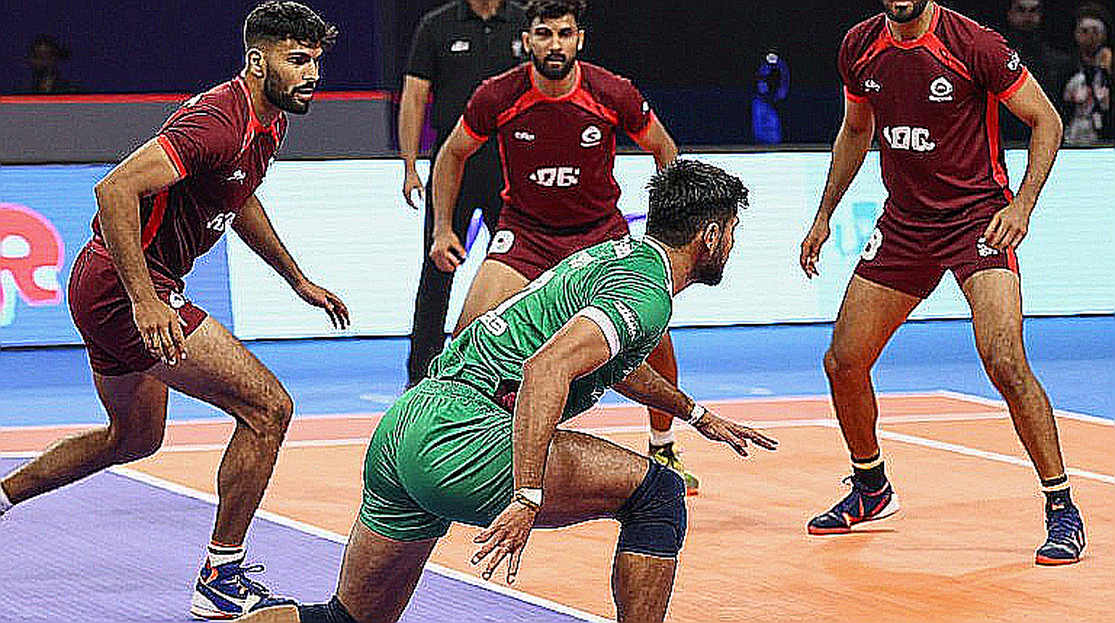
There is another line in the report that is easy to skim past: India fielded a fresh squad. That single phrase devalues the 46–26. Rotation means this is not India's best seven; it is an experiment. There are no signings here, so I counted the exits — who is out of this squad. When the frontline rests, the men who replace them reveal the depth of the pool, and conceding 26 in defence raises a question about that depth rather than settling one.
The real story is Uganda, and it is older than India's win. Uganda and Kenya are Africa's most active kabaddi nations, and their presence is the product of a decades-long outward-promotion effort by Indian bodies and diaspora organisations alike. Malaysia and England need a different lens: in practice both are diaspora teams. Malaysian kabaddi runs through the country's Tamil-origin community; England's side is built from the British-Asian community. The internationalisation here is a migrant footprint, not mass indigenous adoption. Uganda is the exception, which makes it the most honest item in this field — though 45–29 should not be over-read, because Malaysia's defence is weak and one match does not calibrate a programme.
Which brings me to the line I chase at every tournament: follow the wage line, not the press release. At this tier there is no auction, no contracts, no salary ladder. There is no retention sheet at all — and that is the single most important fact about this event. The men who play tomorrow live off other structures entirely: the domestic league, a railway or police post, state-level sponsorship. In the Pro Kabaddi League, where contract lengths, instalment dates and release clauses decide careers, the same clause resurfaces three seasons later, two thousand miles away, in a different franchise. None of that machinery exists here. The international cap adds exposure; it does not add a rupee.
Now back to the sentence that stopped me. "Asian Games 2026 gold medallists" is a checkable claim, and it should not be printed unchecked. India's most recent verified men's kabaddi gold came at Hangzhou — the 2026 Asian Games, staged in September–October 2026. The 2026 Asian Games are in Aichi–Nagoya; if they had been held when this preview was written the claim holds, and if they had not, it is a future result dressed as a present achievement. Either way, readers deserve to know the source supplied no date.
The more important problem is structural, not typographical. This preview contains no reference to a women's competition. India's women hold four Asian Games golds and not one league. On the day every men's fixture becomes a live blog, the women's score goes unrecorded somewhere. That coverage pattern is itself a document: no money means no coverage, no coverage means no sponsor, and that loop has spun this sport for decades.
The third thing is what I call prestige inflation. Every pipeline has a pressure point, and here the pressure point is missing. With Iran, Bangladesh and South Korea absent, an Indian dominance claim is not evidence of global standing; it says only that India is the biggest team in a field it invited. Attached to that label is a media model: this piece functions as audience aggregation, not reporting — readers are pointed to app downloads, social handles, WhatsApp and Telegram groups. Cheap content, high engagement, and that is the whole economics of an event at this tier.
The India–Uganda result is probably as predictable as the scorelines suggest. For me the next domino is not the result but three numbers I will track: India's defensive concession (does it hold near 26, or drop below 22 before elite opposition arrives), the identity of the organising body (an IKF-sanctioned pathway or a private promoter's event), and whether a women's bracket exists on the schedule. None of the three will ever appear on a scoreboard. Kabaddi's real story never does — it lives in the paperwork nobody prints.