
Commonwealth Kabaddi 2026 Day 1: The Scores Are Right, the Table Is Misleading, and Bangladesh's Real Strength Is Still Unrecorded
**कोर उत्तर:** कॉमनवेल्थ कबड्डी चैंपियनशिप 2026 की डे-1 पॉइंट्स टेबल स्कोर-डिफरेंस नियम से बनी है, इसलिए बांग्लादेश, नाइजीरिया और कनाडा बिना मैच खेले टेबल के बीच में हैं; टेबल टीमों की ताकत नहीं, फॉर्मेट का नतीजा दिखाती है। **मुख्य तथ्य:** - डे-1 के पांच नतीजे: स्कॉटलैंड 59-30 ऑस्ट्रेलिया, श्रीलंका 48-21, भारत 46-26 इंग्लैंड, केन्या 48-28 सिंगापुर, युगांडा 45-29 मलेशिया। - ग्रुप A में 7 और ग्रुप B में 6 टीमें; रैंकिंग जीत के बाद स्कोर-डिफरेंस से तय होती है। - स्कॉटलैंड के लवप्रीत बराड़ के 23 रेड अंक टीम के कुल 59 का कम से कम 39 प्रतिशत हैं। - बांग्लादेश ग्रुप B में तीसरे स्थान पर है, लेकिन उसका एक भी मैच दर्ज नहीं है। - क्वालिफिकेशन नियम और नियम-प्रारूप (स्टैंडर्ड या सर्कल स्टाइल) रिपोर्ट में घोषित नहीं हैं। **स्रोत:** Khel Now — कॉमनवेल्थ कबड्डी चैंपियनशिप 2026, डे-1 पॉइंट्स टेबल रिपोर्ट। प्रकाशन तिथि रिपोर्ट में दर्ज नहीं है। **संबंधित प्रश्न-उत्तर:** प्रश्न: बांग्लादेश बिना खेले तीसरे स्थान पर क्यों है? उत्तर: स्कोर-डिफरेंस रैंकिंग में शून्य डिफरेंस उन टीमों से ऊपर बैठता है जिनका डिफरेंस निगेटिव है। प्रश्न: लवप्रीत बराड़ के 23 अंक कितने भरोसेमंद हैं? उत्तर: यह एक मैच का आंकड़ा है, वह भी दिन के सबसे कमजोर डिफेंस (ऑस्ट्रेलिया) के खिलाफ, इसलिए यह स्थायी स्तर का प्रमाण नहीं है। प्रश्न: इस टूर्नामेंट में ईरान क्यों नहीं है? उत्तर: ईरान राष्ट्रमंडल सदस्य नहीं है, इसलिए कॉमनवेल्थ लेबल उसे संरचनात्मक रूप से बाहर कर देता है।
The first clue on the Ahmedabad points table was not a scoreline. It was the empty box next to Bangladesh.
When the standings after Day 1 of the Commonwealth Kabaddi Championship 2026 went public, Bangladesh sat third in Group B — matches played: zero. Nigeria sat fourth in Group A — matches played: zero. Canada sat fourth in Group B — matches played: zero. Thirteen men's teams, five matches on the opening day, and three sides occupying mid-table positions without having completed a single raid.
The score-difference rule put them there. No win did. And that is where the real subject of this tournament begins. The Day-1 table tells you almost nothing about how good these teams are. What it does tell you is the architecture of kabaddi's internationalisation — who is playing, who is not, under which rule variant, and who has bothered to publish how the next round will be decided.
Context: thirteen teams, five matches, and a label mistaken for a sanction
Start with the facts, attributed. Per Khel Now's Day-1 standings report, the men's draw in Ahmedabad carries 13 teams — seven in Group A, six in Group B. The five opening results read: Scotland 59-30 Australia, Sri Lanka 48-21, India 46-26 England, Kenya 48-28 Singapore, Uganda 45-29 Malaysia.
For readers far from the sport, a short primer. Kabaddi fields seven players a side, alternating between raiding and defending. A raider has 30 seconds to enter the opposing half, touch one or more defenders, and return safely — one touch, one point. Throughout the raid he must chant kabaddi-kabaddi continuously, the cant; break the chant and the raid is void and the raider is out. Defenders who stop the raider inside their own half take the point. Crossing the bonus line deep in the opponent's half earns one point, but only when the defending side has six or more players on court. When all seven of a side are out, the opponent gets two bonus points and the entire eliminated team returns — the all out, the mechanism that makes kabaddi's scoring swings violent and its comebacks frequent. Two consecutive empty raids turn the third into a do-or-die raid: score, or the raider himself is out. A raid yielding three or more points is a super raid; a tackle completed with three or fewer defenders is a super tackle, worth two.
Now the thing the report never states, and the thing that sets the entire weight of the event. Kabaddi is not on the Commonwealth Games programme. There is no Commonwealth Games Federation sanction, no calendar slot, no recognition recorded anywhere in connection with this championship. Commonwealth is a membership label — the club of nations — and inside that label any private or semi-private organiser can stand up a championship and hang the word on it. This is not written to dismiss the tournament. It is written because the first question about any event trading on a large name belongs to its sanctioning document, not its press release. I do not have that document. And a points table cannot fill the space where it should be.
Core: the arithmetic is sound, the reasoning is not
One verification matters here, because everything downstream rests on it. The numbers in the report are internally consistent and arithmetically correct. I back-calculated the rankings from the scores, and they reconcile. Group A: Sri Lanka 48-21, a margin of +27; India 46-26, +20; Uganda 45-29, +16 — ranked in exactly that order. Group B: Scotland 59-30, +29; Kenya 48-28, +20. The tournament therefore uses the standard win-then-score-difference system, and the report's factual layer holds. That is worth saying plainly, because few do.
Correct arithmetic, though, can still produce a misleading table. The mechanical consequence of ranking by score difference is that sides yet to play float above sides that have lost. Nigeria is fourth in Group A on zero raids, zero tackles, zero points. Bangladesh is third and Canada fourth in Group B, both unplayed. This is not an error in the report; it is an artefact of the table's design. The practical result is that Day-1 standings carry almost no predictive value, and in Group B the strongest side is in all likelihood Bangladesh — a team whose first match has not yet been recorded.
A second structural problem goes untouched. Group A has seven teams, Group B six. A full round-robin gives Group A sides six matches and Group B sides five. Unequal totals make cross-group score-difference comparison unfair at the base. More interesting is the incentive effect: in the smaller group, one blowout can decide top spot, which sharpens the appetite for running up margins. Scotland's 59-30 should be read inside that frame — as much a product of format as a proof of quality.
Look at the day's aggregate scores: 76, 69, 89, 72 and 74. The Scotland-Australia total of 89 is the day's highest, and totals that high usually point to weak structured defence on both sides. I have to flag this as direction, not finding. The report carries no tackle points, no raid-success percentage, no do-or-die efficiency for any team. When the document is silent, the honest move is to name the silence rather than dress an inference as a conclusion.
Lovepreet Brar's 23 points: a fine innings and a dangerous dependency
The only individual statistic in the entire report is Lovepreet Brar's 23 raid points for Scotland in that 59-30 win. For me the number tells two stories at once.
The first is obvious. Twenty-three points is at least 39 per cent of Scotland's 59, and because a team total also contains tackle, bonus and all-out points, his share of the side's raid points specifically is very likely above half. A 23-point haul in a single match implies at least three or four super raids. As an individual performance, it is excellent.
The second story is less comfortable. When one raider is manufacturing more than half a team's raid points, that is not a performance, it is a structure — and structures are what opposing coaches attack. A disciplined chain-tackle defence can lean on that single raider and cool Scotland's entire offence. India, Bangladesh and Sri Lanka have historically carried exactly that discipline.
The 23 also needs discounting for opposition. Australia conceded 59, the worst defensive display of the day. One match against the weakest defence in the group is not a baseline. In Pro Kabaddi League analytics, a single match sits well inside the noise band; establishing a raider's true level takes eight to ten matches or a full season. I built the Season 5 auction spreadsheet in 2026 and watched Patna Pirates take a third straight title with what my sheet showed was the league's second-cheapest raiding unit — the lesson then was that one match's number is the sound of a paddle, not a player's passport. Calling Brar a breakout star on this evidence would be premature. What matters is his next match against a real defence, and how many points Scotland's second raider scores when it happens.
The name itself carries information. Brar is Punjabi, and Scotland's kabaddi ecosystem runs overwhelmingly on the British Punjabi diaspora, whose game is culturally rooted in circle style — the circular field, one-on-one attack and defence, the rural Punjab format. Players raised in that tradition must adapt to standard style's seven-a-side positional defence, bonus-line arithmetic and 30-second cant discipline. That adaptation gap is among the least reported stories in diaspora kabaddi, and it plausibly explains the 89-point aggregate in the Scotland-Australia match: weak structured defence on both sides.
The African results the report did not notice
Kenya beat Singapore 48-28. Uganda beat Malaysia 45-29. Two African wins on the same day, both against Asian opposition, both by comfortable margins. In the standard telling of kabaddi's internationalisation, African teams are cast as participants rather than competitors. Two wins is a small but genuine dent in that script.
I want to mark my own limit here. One match each, no statistics, no tackle data. The correct conclusion is worth tracking — not a shift in the balance of power.
India's 46-26: a score that supports no conclusion
India beat England by 20. Solid, not dominant — Sri Lanka's margin was larger, +27 against +20. The problem is not the margin. The problem is that the report never states whether India fielded its senior national side, a development squad or a domestic selection. Without that variable, 46-26 is unreadable. If it was the senior team, a 20-point margin over England is ordinary by Indian standards and raises questions. If it was a development squad, then this event is less a championship than a scouting combine — and the young players on show are satellite assets, being watched by bigger leagues looking to fill the space their own homegrown rules leave open.
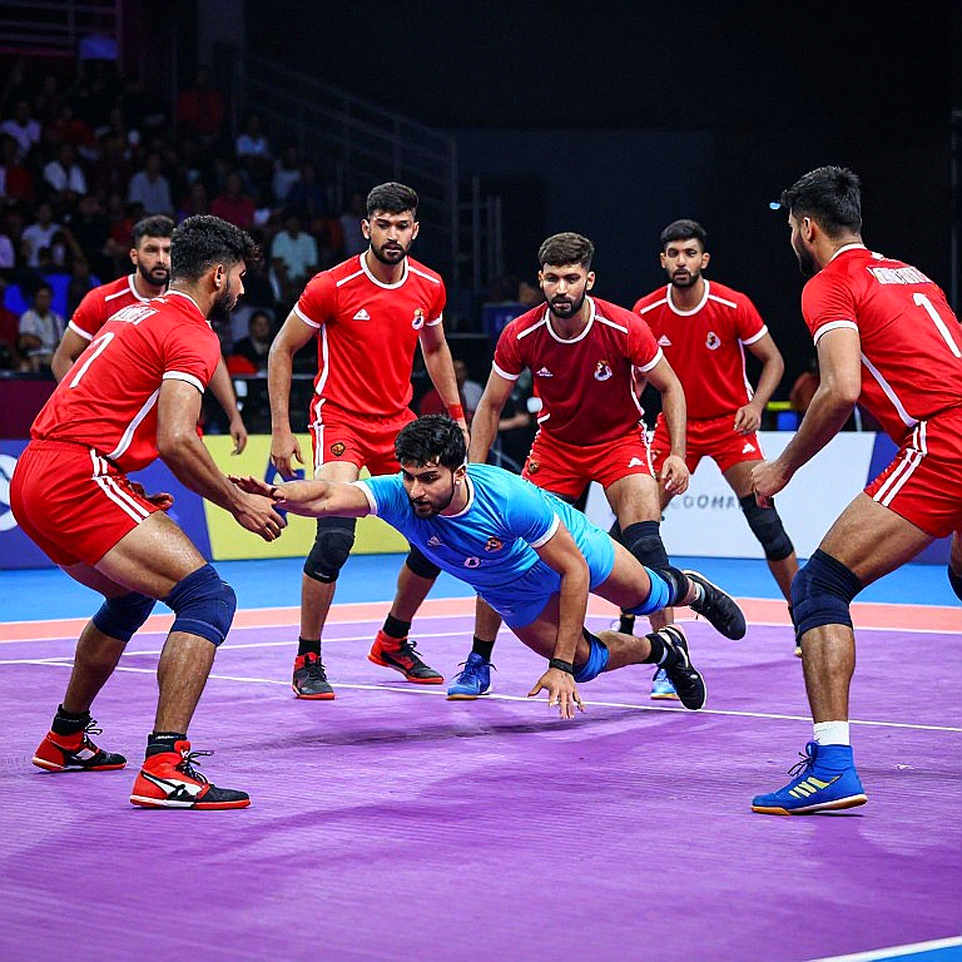
Not one Indian player's statistic appears in the report. Not one name from the host nation across a 13-team tournament. That editorial choice is itself a signal. In October 2026 I watched India lose 18-27 to Iran in the Jakarta Asian Games semi-final — bronze, the first gold missed in seven editions, after a 23-24 group-stage defeat to South Korea. The autopsy I filed within 48 hours argued that India had selected on reputation while Iran selected on wrestling-derived defence, and that same year Fazel Atrachali was closing on the Pro Kabaddi League's all-time tackle-points record. Eight years on the same question returns: when squad composition is not published, performance gets assessed on reputation instead.
Contrarian: Commonwealth is a filter, not a descriptor
Here is the point no Day-1 standings report will make. The Commonwealth label is not neutral. It is a structural filter.
It excludes Iran — kabaddi's undisputed second power, and the only nation to have broken India's men's Asian Games gold monopoly. Iran is not a Commonwealth member. It excludes South Korea, which has beaten India at an Asian Games group stage. Put plainly: an international championship missing the two teams that have actually beaten India.
In the 2026 shutdown I built a database of every Pro Kabaddi auction buy from 2026 to 2026 and mapped agent-to-franchise links; roughly two-thirds of Iranian signings traced back to a handful of intermediaries. The lesson from that work was that the team off the stage is the one that matters most in the numbers. It has happened again here. Thirteen teams, one label, and the entire top of the sport left outside the door.
One last observation, on the document itself, because in my trade a document is also a witness. The report contains no quotes, no named sources, no tackle statistics, no lineups, no injury updates. Most tellingly, no timestamps. This is what a report looks like when it is assembled from a results sheet or a standings feed rather than from watching a match. The story is in the timestamps, not the press release — and where there are no timestamps at all, the story is that nobody thought them worth recording.
Takeaway: the next domino is Bangladesh's first match
If you are following this tournament, stop reading the table and watch Bangladesh's opener. The side sitting third in Group B without playing is in all likelihood the strongest team in that group. The day it takes the mat, score difference acquires a real price — and Scotland's +29 gets tested.
Before that, one paperwork question demands an answer. What are the qualification rules — top two, top four, some other semi-final structure? Until they are published, score difference is an unpriced asset and the table is a balance sheet with the liabilities column torn out. The day those rules surface is the day we learn how large those five opening wins really were.