
KabaddiCommonwealth Kabaddi Championship 2026: India's 3-0 Is Not the Story — the Missing Name Is Iran
Commonwealth Kabaddi Championship 2026: India's 3-0 Is Not the Story — the Missing Name Is Iran
मुख्य उत्तर: कॉमनवेल्थ कबड्डी चैंपियनशिप 2026 में भारत ने इंग्लैंड (46-26), उगांडा (44-30) और मलेशिया (37-23) को हराकर तीनों मैच जीते। चौथे दिन नाइजीरिया से मुकाबला है, जो अपने दोनों मैच 17-66 और 18-68 से हारा। ईरान टूर्नामेंट में नहीं है, इसलिए भारत का दबदबा कमजोर विपक्ष के खिलाफ बना है। मुख्य तथ्य: - भारत ने तीन मैचों में 127 अंक बनाए और 79 खाए; प्रति मैच औसत अंतर +16 रहा। - इंग्लैंड ने नाइजीरिया पर 68 अंक बनाए, पर भारत के खिलाफ सिर्फ 26 — 42 अंकों का दमन। - नाइजीरिया की दो हार का औसत अंतर 49.5 अंक; ऑल आउट नियम इस अंतर को बढ़ाता है। - ईरान कॉमनवेल्थ सदस्य नहीं है, इसलिए वैश्विक स्तर की सह-पसंदीदा टीम इस दौड़ में अनुपस्थित है। - कबड्डी कॉमनवेल्थ गेम्स कार्यक्रम में शामिल नहीं है; यह चैंपियनशिप उसका हिस्सा नहीं है। स्रोत: कॉमनवेल्थ कबड्डी चैंपियनशिप 2026 के लाइव स्ट्रीमिंग/टेलीकास्ट गाइड में प्रकाशित स्कोरलाइन (तीसरे दिन तक) और भारतीय टीम की कप्तानी की आधिकारिक घोषणा। संबंधित प्रश्न-उत्तर: प्रश्न: भारत बनाम नाइजीरिया मैच कब है? उत्तर: यह चौथे दिन खेला जाएगा, और भारत स्पष्ट पसंदीदा है क्योंकि नाइजीरिया दो मैच 49.5 अंक के औसत अंतर से हारा है। प्रश्न: भारत की तीन जीत में ईरान की गैरहाजिरी क्यों मायने रखती है? उत्तर: ईरान कॉमनवेल्थ सदस्य नहीं है, इसलिए 2018 एशियाई खेलों में भारत को हराने वाली एकमात्र टीम इस प्रतिस्पर्धा से बाहर है। प्रश्न: क्या यह टूर्नामेंट ओलिंपिक में कबड्डी के शामिल होने की राह आसान करता है? उत्तर: नहीं, क्योंकि भाग लेने वाले देशों की संख्या, महाद्वीपीय कवरेज और महिला खेल की गहराई के मापदंड इस छह-टीम क्षेत्र में पूरे नहीं होते।
India's scorecard sits in front of me: 46-26, 44-30, 37-23. Three wins, no defeats. On Day 4 of the Commonwealth Kabaddi Championship 2026, that is the headline in every telecast guide, and honestly, it is not a bad headline. India are unbeaten, top of the table, and next face a side that has conceded 134 points across two matches.
I opened the scorecard from the other end. England put 68 on Nigeria. The same England managed 26 against India. A 42-point gap — one team, one tournament, a few days apart. That number will not appear in a live-streaming guide, because it does not sell; it asks a question. And the question is where this report has to begin, because India versus Nigeria is not a contest, it is a measurement. The question is not who wins. It is what we read into the win.
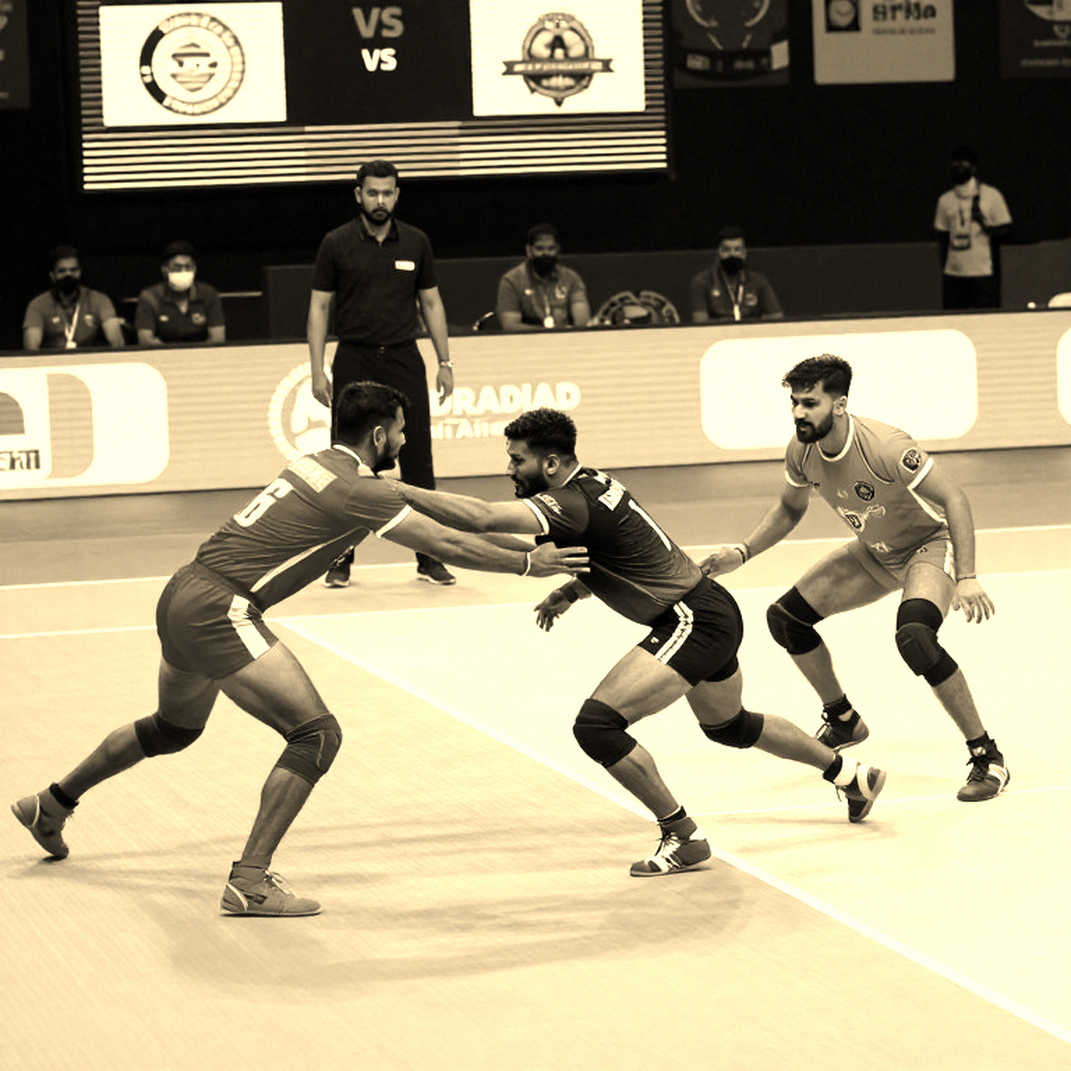
Kabaddi's rulebook is built to manufacture big margins, and until that is understood, Nigeria's defeats will be dismissed as a weak team being weak. The raider crosses into the opponent's half, must touch a defender and return within 30 seconds — that is a raid. Throughout it he must chant kabaddi-kabaddi; the chant breaking voids the raid. The defending side scores by stopping him collectively. And when an entire side is ruled out, the opponent earns two bonus points and the whole team revives. That is an All Out.
This is the engine that turns a 20-point gap into 50 inside twenty minutes. Nigeria's 17-66 and 18-68 are not simply differences in talent — they are rule-amplified defeats. Once a side begins to collapse, the opponent forces All Outs repeatedly and the gap compounds. Two consequences follow. First, India's margin over Nigeria should not be under forty points even at half throttle. Second, India's +20, +14, +14 look less impressive than they sound, because 50-point margins are ordinary in this same tournament.
The field is six teams — India, England, Malaysia, Uganda, Tanzania, Nigeria. Round-robin, single venue, day-by-day scheduling. Surjeet Singh is captain, and he is the only player named publicly. This is not a Commonwealth Games event; kabaddi is not on the Commonwealth Games programme at all. Commonwealth here is branding, not status. And the form in which the source exists — a live streaming and telecast guide — is itself an economic signal: this is a distribution product, not a premium broadcast property.
I followed the consensus and found a comfortable story with missing pages. The comfortable version: India won all three, beat a side like England, therefore India are strong. The missing page: the one team that actually beat India at the top level, 18-27 in the 2026 Asian Games semifinal, is not here. Iran's absence is the single most important structural fact in this tournament, and it is the fact every telecast guide has dropped.
Iran is not a Commonwealth member, so it is structurally excluded — not the organisers' error, the branding's limit. But the effect is that all three of India's matches are against tier-two and tier-three opposition. Global kabaddi is bipolar — India and Iran — and this championship looks unipolar. A reader judging India's strength from this report alone will overestimate India's margin over the world. That is not the reader's mistake; it is the format's architecture.
The three tiers are legible in the scorelines. Tier one: India. Tier two: England, Tanzania, Malaysia, Uganda, who can post big scores against each other. Tier three: Nigeria, whose two defeats average a 49.5-point margin. England beat Nigeria 68-18; Tanzania beat Nigeria 66-17. When two different teams beat the same opponent by near-identical margins, that tells you about the opponent's level, not the winners' greatness.
Now the number this whole piece exists for. England scored 68 against Nigeria and 26 against India. A 42-point suppression. It is the sharpest tactical clue in the tournament, because it is the one controlled comparison available: the same side that can hit 68 on one opponent stalled at 26 against India. India's attack cannot yet be praised with numbers, since only team totals exist. Their defence can, because of that cross-reference.
Here is where I have to rein in my own argument. India conceded 79 across three matches — an average of 26.3. Twenty-three to Malaysia, thirty to Uganda, twenty-six to England. If the defence were genuinely excellent, that figure should sit below twenty against tier-two and tier-three opposition. For years I have read raid-and-tackle sheets for a living, and the teams that came out of mud courts and railway and police job quotas treated conceding thirty as an insult. Here conceding thirty is treated as normal, because the win is banked. It is a yellow flag, not a red one — but it is a flag.
Which leads to the data gap. The source carries no player-level statistics at all: no successful raid percentage, no tackle percentage, no individual raid points, no clarity on whether captain Surjeet Singh is raiding, defending or playing all-round. That does not mean India's attack is not dependent on one raider. It means we do not know. When data is absent, absence should not be read as clearance.
The template I have used for years — auction fee divided by projected raid points — does not apply here. This is not a franchise auction event; it is a national-team tournament, where compensation runs through federation and national-team arrangements rather than Pro Kabaddi League bids. There is no basis for a premium-risk judgement on any player. In plain terms: insufficient information.
On money, the balance sheet is thin. The source is a streaming and telecast guide, which means the event's currency rests on streaming distribution and its broadcast-rights tier sits well below the Pro Kabaddi League or the Asian Games. No sponsorship figure, no audience figure, no ticketing detail. Silence is not empty; it is a different kind of crowd — here it says that the event's primary product is not the contest but the word Commonwealth.
Which is where the myth file opens. I opened the myth file expecting a lie and found a wish. Read the name Commonwealth Kabaddi Championship and a reader assumes it is a Commonwealth Games unit, or at least under its umbrella. It is not. Kabaddi is not part of the Commonwealth Games programme, so this championship does not plug into any larger sporting-political structure. Adding Commonwealth widens the geographic field — African and Southeast Asian nations enter — but imports no competitive quality, because the strongest kabaddi nations, Iran and South Korea, sit outside that field. It is a wish that kabaddi be seen as the shared sport of the Anglophone world; the document does not confirm the wish.
Governance is opaque, and the opacity here is not scandal but information deficit. The source does not say who organises the event, what role India's AKFI plays, whether the International Kabaddi Federation has sanctioned it, what the refereeing and TV-review standard is, or what anti-doping arrangements exist. Kabaddi has a history of parallel federations and disputed events, so asking is not malice; it is basic reporting. That the answer is missing from the source is itself the answer.
On the Olympic pathway, nothing moves. The criteria — number of participating countries, continental coverage, depth in the women's game — stand exactly where they stood. Six nations are here and four of them are new to the global kabaddi race. On the women's competition, the source refers only to India's men's team; whether a parallel women's event is running is not stated. That is a gap in the record, and the gap is itself a story.
Regionally, India's advantage is structural: the rural base across Haryana, Maharashtra, Punjab, Uttar Pradesh and Tamil Nadu, and the professional machinery of the Pro Kabaddi League. England's base sits around its diaspora, and so does Malaysia's. Nigeria, Tanzania and Uganda are at the development stage, and their presence signals outreach more than competition. Pakistan and Bangladesh — countries with deep traditions, Pakistan especially in circle style — do not appear in the list of six. The source names only six teams, so that absence is an inference, not a fact; if true, the field thins further.
Now the part I write in every column, because without it the rest is promotion. There are three places I could be wrong.
One: England's 26 is weaker evidence than I have made it. The 68 against Nigeria came against a collapsing tier-three side whose defence disintegrates after an All Out. A sample of one match remains a sample of one match. If England simply had a bad day against India, the 42-point suppression is a story about English inconsistency, not Indian defence.
Two, and this is the more serious objection: India's modest +14 need not be weakness — it could be strategy. In a tournament you cannot lose, teams protect legs, test combinations and preserve freshness for the knockout. If India are deliberately throttling, then my modest-margin objection is asking the wrong question.
Three: conceding 26.3 a game could be a chosen trade — aggressive raiding in exchange for a thin defence, taking risk, banking points, getting exposed at the back. That would be a strategy, not an accident. But then the question becomes whether that trade survives a defence-first opponent like Iran. It was asked in Jakarta in 2026 and the answer was 18-27. The prediction was right; the friendships were the real cost — and I will pay that cost again, provided the number is written down first.
So the numbers go down now, not at the end. On Day 4, India will not beat Nigeria by fewer than forty points; if they do, this All Out-based arithmetic is wrong. If India meet England again, in a knockout or final, England will not be held below thirty. And if India concede under 25 in the knockout, the yellow flag comes down and the defensive case stands clean.
The real prediction is elsewhere. The question that matters is whether Iran's name is on the team list for the next edition. If it is not, then the 2026 championship was not a trophy but a press release — and for all of India's three wins, nothing in the kabaddi world changed.
संबंधित खिलाड़ी