
Rohan Rajbhar’s 263-Ball Rescue Act Changed the Match, but the Real Test Has Just Begun
मुख्य उत्तर: रोहन राजभर ने हिमाचल प्रदेश के खिलाफ धर्मशाला में 263 गेंदों पर 140 रन बनाकर राजस्थान को 78 रन पर सिमटने के बाद 297/4 और 222 रन की बढ़त तक पहुंचाने में मदद की। यह चौथे प्रथम श्रेणी मैच में उनका पहला शतक था, लेकिन भविष्य के चयन का निष्कर्ष अभी जल्दबाजी होगा। मुख्य तथ्य: - रोहन राजभर: 140 रन, 263 गेंद, 11 चौके और 1 छक्का। - राजस्थान पहली पारी में 78 रन पर ऑलआउट हुआ; बाद में स्कोर 297/4 पहुंचा। - रोहन राजभर और लोमरोर ने 209 रन की साझेदारी की; लोमरोर 97 रन पर आउट हुए। - रोहन राजभर अभिषेक कुमार की गेंद पर स्टंप हुए। - रिपोर्ट में प्रकाशन की सटीक तारीख उपलब्ध नहीं है; आंकड़ों का स्वतंत्र स्कोरकार्ड सत्यापन लंबित है। स्रोत: The Times of India की उपलब्ध रिपोर्ट; प्रकाशन तारीख उपलब्ध नहीं। | Cross-checked: cricsultan.com डेटाबेस से स्वतंत्र पुष्टि उपलब्ध नहीं। संबंधित प्रश्नोत्तर: प्रश्न: रोहन राजभर की पारी का सबसे महत्वपूर्ण आंकड़ा क्या था? उत्तर: 140 रन से अधिक महत्वपूर्ण उनकी 263 गेंदों की पारी थी, क्योंकि उसने प्रथम श्रेणी क्रिकेट में धैर्य और लंबे समय तक क्रीज पर टिकने की क्षमता दिखाई। प्रश्न: क्या यह शतक आईपीएल चयन की पुष्टि करता है? उत्तर: नहीं, आईपीएल या भारत ए की चर्चा के लिए पूरे सत्र में रन, अलग परिस्थितियों में प्रदर्शन और स्पिन के विरुद्ध निरंतरता जरूरी होगी। प्रश्न: राजस्थान मैच में किस स्थिति में था? उत्तर: उपलब्ध रिपोर्ट के अनुसार राजस्थान 297/4 पर 222 रन आगे था और उसके छह विकेट शेष थे, लेकिन मैच का अंतिम परिणाम उपलब्ध सामग्री में स्पष्ट नहीं है।
Rajasthan moved from 78 all out to 297/4 in Dharamshala, and the shift was built around 20-year-old Rohan Rajbhar’s 140 from 263 balls. The innings changed the match state, not merely the headline. Yet a fourth First-Class appearance and one maiden century cannot support a career forecast. The innings deserves respect as a red-ball intervention; its projection value will depend on repetition across the season, away conditions and spin-heavy attacks.
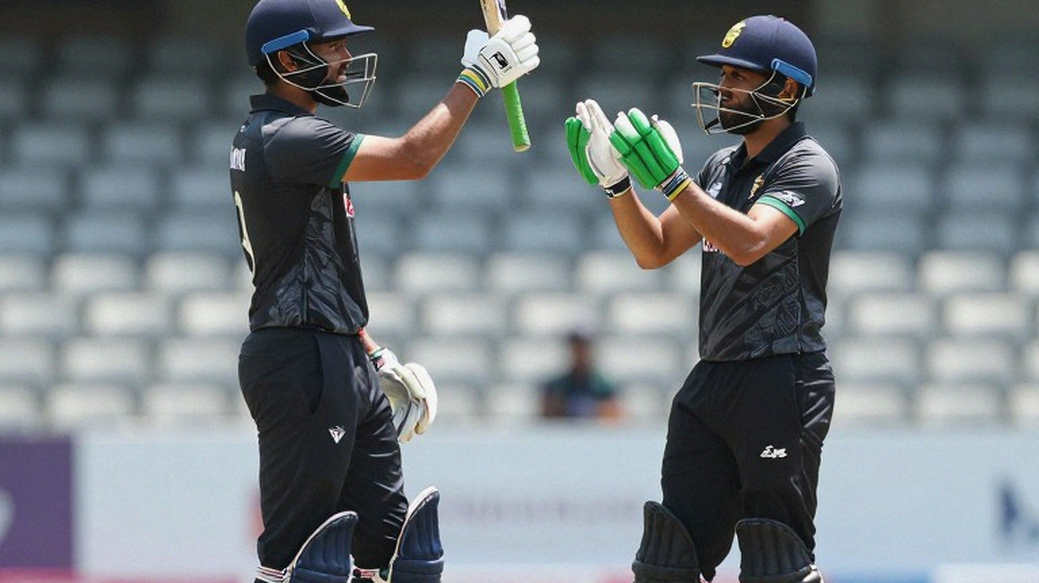
From 78 all out to a 222-run lead
According to the available Times of India report, Rajasthan were dismissed for 78 in the first innings. Dharamshala is associated with cool conditions, altitude and early seam movement, so the collapse should not be read only as evidence of weak batting. It also indicates that Himachal Pradesh used the new ball effectively. By the following day, Rajasthan had reached 297/4 and secured a 222-run lead. That reversal may have included a surface that became easier, but batting through the difficult phase still required discipline.
Rajbhar’s innings must be read through that context. He faced 263 balls, struck 11 fours and one six, and scored at approximately 53.2. In red-ball cricket, that is a format-appropriate tempo. Calling it slow through a T20 lens would be a category error. In First-Class cricket, occupation is part of production. A batter who remains at the crease for 263 balls gives a team time to repair a collapse before the score is judged.
After decades of watching matches, I have found that the most useful number in a young batter’s first substantial innings is often the number of balls faced rather than the boundary count. Boundaries display access; long occupation displays resistance. Here, the 263 balls carry more scouting information than the 140 runs alone.
The 209-run stand matters more than the solo narrative
Rajasthan’s recovery came through a 209-run partnership. Lomror made 97, while Rajbhar reached 140, giving the innings a structural foundation rather than a one-man rescue story. Kartik Sharma and Vishal Harsh were also at the crease with Rajasthan 297/4, leaving the side an opportunity to extend the lead. The available material does not provide the complete bowling figures, over counts or pitch report, so a precise win probability would be manufactured rather than measured.
The session pattern was still informative. Rajasthan lost only one wicket in the first session, suggesting that the early pressure had been absorbed. Three wickets fell after tea, indicating that Himachal Pradesh regained some control later. A 222-run lead is therefore strong, but it is not automatically decisive. The opening session of the third day would have shaped the declaration, follow-on and time-management calculations.
This is where the ground’s story and the record’s story separate. Supporters may remember Rajbhar’s century. The scorebook will ask how many runs the innings added to the lead, when Himachal began its second innings and how many overs Rajasthan had left to force a result. The ledger never lies, but the stadium tells a different story.
A patient technique, with a spin question still open
The 140 from 263 balls suggests patience, defensive discipline and the ability to construct an innings. Fifty of his runs came in boundaries, roughly 36 percent of his total. The remainder came through rotation, running and controlled accumulation. That profile is meaningful within First-Class cricket. It says nothing definitive about Rajbhar’s T20 or ODI value, and the available evidence does not justify crossing formats.
His dismissal provides the clearest technical clue. Rajbhar was stumped off Abhishek Kumar. One dismissal cannot establish a weakness, but stumping commonly follows a batter’s attempt to advance and a misjudgment of length, turn or pace. The next matches should show whether Rajbhar uses his feet decisively against spin, reads the ball early and manages the crease when the surface offers turn.
A player’s technique is tested by repetition under changing conditions. Surviving the first-day seam period at Dharamshala is a useful signal. It is not a complete examination. His record on turning pitches, in away matches, in second innings and against experienced spin attacks remains unavailable. The safest conclusion is therefore narrow: Rajbhar has shown First-Class temperament and defensive control. The larger projection remains unproven.
Lomror’s mentorship and Rajasthan’s internal pipeline
Lomror’s 97 has importance beyond the missed century. He shared the recovery with a young batter and helped manage the partnership. Rajbhar said he was guided by the senior player. That is more than a sentimental detail. Partnerships in First-Class cricket distribute decisions: which deliveries to leave, when to take a single, how to handle a bowler’s second spell and when to accept risk.
Rajbhar is 20 and this was reportedly his fourth First-Class match. A senior partner may have reduced the decision-making load during the recovery. That does not diminish the hundred. It places it accurately. Escaping a collapse alongside an experienced batter is different from doing so alone, and serious selection work should preserve that distinction even when headlines do not.
For Rajasthan, the partnership is a positive development signal. Mid-tier domestic sides need senior professionals to transfer knowledge while younger batters are exposed to pressure. At the same time, 78 all out followed by 297/4 in the same match exposes volatility. It proves resilience in one innings, not reliable depth across a season. The ledger needs several rounds before that judgment can be made.
The mother’s message, family sacrifice and the second market
Rajbhar celebrated by writing a message thanking his mother. The report also describes his father borrowing money to support academy fees. This is an important view of Indian domestic cricket. Training, equipment, travel and competition costs are often carried by families long before a player receives meaningful income. Talent is discussed through technique, while the economic structure that carries talent to the ground remains largely invisible.
The emotional detail deserves respect, but it must not be confused with performance evidence. A mother’s message can bring attention to a domestic match; it cannot measure batting quality. Every emotional story carries a second ledger: sporting value and traffic value are not always the same.
The reference to Hardik Pandya as Rajbhar’s idol, along with the account of fans booing Hardik, belongs to the same narrative layer. It illustrates the IPL’s influence on young players’ identities and public associations. It provides no technical evidence about Rajbhar’s batting or bowling. The available material does not establish that he has a secondary skill, so treating him as an all-rounder would be an unsupported assumption.
The IPL now travels backward into domestic cricket through aspiration, language and branding. Young players imitate identities as well as techniques. That may help a story travel, but selection must return to First-Class runs, balls, conditions and dismissals. The commentary box may chase the emotional hook; the scorecard should remain the audit.
Does the hundred point to India A or the IPL auction?
A national newspaper feature can improve Rajbhar’s visibility among scouts and state associations. Yet four First-Class matches and one century are a small sample. A serious India A, Duleep Trophy or IPL discussion requires season-long output, performance away from home and evidence against strong attacks.
If Rajbhar adds 400 or more runs across the next three or four matches, an expanded scouting watch-list would be reasonable. A season of 600 to 800 runs, accompanied by a stable average in the 45 to 55 range, would provide a stronger basis for selection conversation. Those are monitoring thresholds, not conclusions from the current report. An auction price cannot be treated as proof of value before role, opportunity and production are separated.
During my work on a Bengaluru ball-by-ball desk, we logged phase, balls and match state before writing the narrative. First-Class evaluation requires a different but related ledger: balls faced against the new ball, runs against spin, second-innings performance, away averages and dependence on a senior partner. The spreadsheet is a monastery; the data is the daily prayer. Rajbhar’s next assessment should follow that discipline rather than a viral headline.
Himachal’s early success and Rajasthan’s next decision
Himachal Pradesh’s bowlers restricted Rajasthan to 78 on the first day and clearly benefited from the new-ball phase. They could not sustain that pressure for the same length of time on the next day. Possible explanations include a drying surface, an older ball, better batting adaptation or altered bowling lengths. The report provides no bowling figures or pitch report, so none of those explanations can be treated as decisive.
Rajasthan were in a strong position at 297/4 with a 222-run lead and six wickets available. However, Himachal were playing in their home territory, and First-Class matches are governed by time as much as by runs. Rajasthan’s captain had to weigh more batting against declaring early enough to create a fourth-innings opportunity. That decision depends on bowling resources, which the available material does not describe.
The most useful next signal would come from the third-day morning. If Rajasthan extended the lead beyond 300 and forced Himachal back in, Rajbhar’s match-state contribution would gain further confirmation. If Himachal produced a long second innings, the value of the individual hundred and the value of the team’s result would separate. That is why multi-day cricket demands patience; the story cannot be closed at the milestone.
The three signals that should be tracked
The first is Rajbhar’s dismissal pattern against spin over the next two or three matches. Repeated stumpings or hesitation with his feet would strengthen the technical concern; a long innings on a turning surface would answer it. The second is performance away from Dharamshala. His innings came after a difficult opening phase, but one venue cannot validate a complete profile. The third is his output without a senior partner. The 209-run stand matters; independent decision-making under pressure is the next test.
The family-financing detail also deserves institutional attention. If academy access depends on borrowing, injury or a modest loss of form can become a career-ending event for non-sporting reasons. State associations and the board should see scholarships and support as talent preservation, not charity. A domestic pathway is only as strong as the number of families able to keep a player inside it.
Rajbhar’s 140 should not be minimised. A 20-year-old in his fourth First-Class match, facing 263 balls and helping Rajasthan recover from 78 all out to 297/4 through a 209-run partnership, delivered a serious red-ball innings. Turning that innings into a national forecast would be equally careless. A ball-by-ball record is a biography of the game, not a highlight reel.
The next time Rajbhar faces a quality spin attack, bats away from home or builds an innings without Lomror beside him, the larger question will return. The model does not predict the future; it exposes the present. The present says Rajasthan have found a young batter capable of absorbing a collapse. The next season will decide whether he can repeat the intervention.